
Is Your Tap Water Safe in The Woodlands? How to Find Your MUD and Read Your Water Report
If you have searched whether the water in The Woodlands is safe, you have probably landed on a page that ends with a water softener for sale. The useful answer is shorter: it depends on which district serves your home, and you can check that yourself in about ten minutes.
Last reviewed: October 6, 2026, by Jen Knoedl
The short answer
Homes in The Woodlands get water from regulated public systems that must meet federal and Texas drinking water standards and publish their results every year. Whether your water had a problem last year is written down in your district's annual report. This guide shows you how to find that report, which parts to read, and how to decide whether you need to do anything at all.
Why there is no single "Woodlands water report"
The Woodlands is not a city with one water department. Water reaches homes through municipal utility districts, or MUDs, which are local government districts that provide water and sewer service to a defined area.
Here is how the pieces fit:
The San Jacinto River Authority (SJRA) Woodlands Division is the wholesale supplier. It runs the wells and treatment plants. The water is a blend of groundwater from wells in the Evangeline and Jasper aquifers and Lake Conroe water treated at SJRA's surface water plant, mixed in storage tanks before it reaches the system.
Woodlands Water handles retail service, billing and customer questions for 10 MUDs: The Woodlands MUD No. 1; Montgomery County MUDs 6, 7, 36, 39, 46, 47, 60 and 67; and The Woodlands Metro Center MUD.
Creekside Park is separate. It is served by Harris-Montgomery Counties MUD 386. The district runs two water systems: the Harris County side buys groundwater from Harris County MUD 387, and the Montgomery County side buys the same blended SJRA water as the rest of The Woodlands.
Conroe, Magnolia and unincorporated areas are served by city utilities, their own MUDs or water supply corporations, or private wells.
Each system publishes its own report, which is why a single "Woodlands" number on a sales page does not tell you much about your tap.
Where you live | Who supplies your water | Where to find your report |
|---|---|---|
The Woodlands villages (most) | One of 10 MUDs managed by Woodlands Water | woodlandswater.org, Water Quality Reports (2025 reports posted) |
Creekside Park | Harris-Montgomery Counties MUD 386 | Not posted on hmcmud386.org; call the district at 281-290-6507 or search "MUD 386" in the TCEQ Drinking Water Viewer |
City of Conroe | City of Conroe Public Works (its 2025 report lists groundwater as the source) | City of Conroe Consumer Confidence Reports (2025 report posted) |
Magnolia and other areas | Your city, MUD or water supply corporation | Your bill, or the TCEQ Drinking Water Viewer |
Private well | You | No annual report; testing is your responsibility |
Step 1: Find out who supplies your water
Check your water bill. The district name is usually printed on it.
In The Woodlands, use the Woodlands Water address lookup (woodlandswater.org, "Find Your MUD"). Boundaries on the map are approximate, so if you are near an edge, call Woodlands Water at 855-426-7283 to confirm.
Renting? You may not get a water bill. Ask your property manager which system serves the building.
Anywhere in Texas, you can search the TCEQ Drinking Water Viewer by system name or county to see a system's violations and sample results. (It replaced the older Drinking Water Watch tool, so ignore guides that still send you there.)
On a private well? There is no utility report. Texas puts testing responsibility on the well owner and recommends using an accredited laboratory. Texas A&M AgriLife's Texas Well Owner Network runs periodic well water screenings around the state.
Step 2: Get your Consumer Confidence Report
A Consumer Confidence Report (CCR), sometimes called an annual water quality report, is a summary every community water system must send customers by July 1. It covers the previous calendar year and lists where the water comes from, any regulated contaminants that were detected, whether the system broke any rules, and who to contact with questions.
The format is changing. Starting in 2027, systems serving more than 10,000 people must send reports twice a year and open with a plain-language summary of violations and compliance. Until then, most reports are a few pages of tables.
If you cannot find yours on your utility's site, call the number on your bill or use EPA's Find Your Local CCR search.
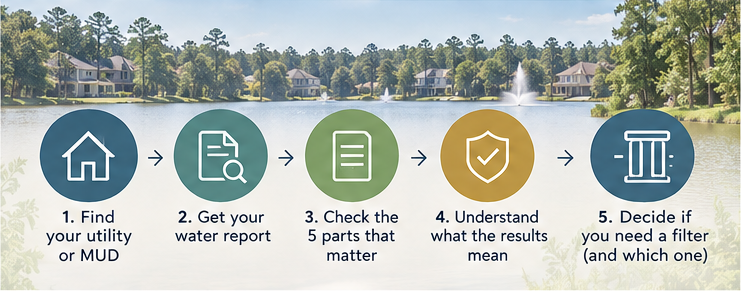
Step 3: Read the five parts that matter
You do not need to read every line. These five sections answer most of what people actually want to know.
The violations section
Start here. Look for any statement that the system had a violation, exceeded a limit, or missed required monitoring or reporting. A monitoring or reporting violation means paperwork or sampling was late or missed; it is different from a limit being exceeded, and the report should say which. No violations listed is a good sign.
The detected contaminants table
This is the table that confuses people most, mostly because of one word: detected. Modern lab methods can find extremely small amounts of substances. A substance appearing in this table means it was measured, not that it was above a safety limit.
For each row, compare the highest level detected with the MCL in the same row.
Term on the report | What it means in plain English |
|---|---|
MCL (Maximum Contaminant Level) | The highest level allowed in drinking water: the legal limit |
MCLG (Maximum Contaminant Level Goal) | The level below which there is no known or expected risk to health, with a margin of safety. It is a goal, not the legal limit, and for some substances it is zero |
Action Level | For lead and copper: the level that, if exceeded, triggers extra steps by the utility |
Range | The lowest and highest results across samples |
ppm / ppb / ppt | Parts per million, billion or trillion; units get smaller in that order |
These definitions follow the standard wording printed in every Woodlands Water report.
Lead and copper
Lead usually comes from service lines and plumbing inside or near a home, not from the source water, so a system can deliver clean water to a home whose own pipes or fixtures add lead. Reports show a 90th percentile result compared with an action level. Utilities now also keep an inventory of service line materials; in The Woodlands, the 2025 reports say it can be viewed at the Woodlands Water office, 2455 Lake Robbins Drive. A 2024 federal rule lowers the lead action level from 15 to 10 parts per billion starting in late 2027. That rule is being challenged in federal court (arguments were heard in September 2026), so the date could still change.
Disinfectant and disinfection byproducts
Public water is disinfected to control germs. The report lists the disinfectant level and results for disinfection byproducts, usually shown as TTHM and HAA5. Compare each with its MCL in the same table. All 10 Woodlands Water reports for 2025 list free chlorine as the disinfectant, and the City of Conroe's 2025 report lists chlorine gas. That matters if you choose a filter: a carbon filter certified for chlorine taste and odor fits these systems. MUD 386 (Creekside Park) does not post its report online, so check its report for its disinfectant before choosing a filter.
Source water and the extra tables
Near the front you will see where the water comes from. Some reports also include "secondary" constituents (things that affect taste, odor or appearance and are not health-based) and "unregulated" monitoring results, which EPA collects to decide whether future rules are needed. Results in these tables are information, not violations.
What the 2025 Woodlands reports show
Every compliance result in the 10 Woodlands Water reports for 2025 is under its legal limit, and all 10 districts receive the same blended SJRA water. Differences between districts mostly come from sampling inside each district's pipes.
District | Violations listed | Routine samples positive for total coliform | Lead, 90th percentile (ppb; action level 15) | Highest TTHM running average (ppb; MCL 80) | PFAS (EPA UCMR 5 monitoring) |
|---|---|---|---|---|---|
The Woodlands MUD 1 | None | 0 | 1.07 (2021 to 2023) | 41 | All below reporting levels |
Montgomery County MUD 6 | None | 0 | 3.32 (2024) | 59 | All below reporting levels |
Montgomery County MUD 7 | One lead and copper monitoring violation (a sample came from an unapproved site; resampling scheduled for 2026) | 1 (November); follow-up assessment completed | 1.7 (2023 to 2025) | 58 | All below reporting levels |
Montgomery County MUD 36 | None | 0 | 1.16 (2021 to 2023) | 38 | All below reporting levels |
Montgomery County MUD 39 | None | 1 (February) | 0.634 (2023 to 2025) | 43 | All below reporting levels |
Montgomery County MUD 46 | None | 1 (September) | 2.46 (2021 to 2023) | 49 | One PFBA result at the reporting level (0.0051 vs 0.005 µg/L); all others below |
Montgomery County MUD 47 | None | 1 (July) | 0.703 (2023 to 2025) | 39 | All below reporting levels |
Montgomery County MUD 60 | None | 1 (October) | 3.16 (2021 to 2023) | 53 | All below reporting levels |
Montgomery County MUD 67 | None | 1 (May) | 0.833 (2022 to 2024); 1 sampled home above 15 | 70 | All below reporting levels |
The Woodlands Metro Center MUD | None | 1 (December) | 1.42 (2022 to 2024) | 42 | Not stated in the report |
How to read this calmly: total coliform is an indicator bacteria, and a positive routine sample triggers follow-up testing. A monitoring violation means a sampling rule was not followed, not that a limit was exceeded. One home above the lead action level points to that home's plumbing, which is why the lead section above matters. Source: each district's 2025 report, linked from Woodlands Water. Update this table every July.
Hard water is not the same as unsafe water
If your main complaint is spots on glasses, crust on faucets or soap that will not lather, that is a hardness question, not a safety one. Hardness comes from calcium and magnesium, which the US Geological Survey describes as not toxic, and there is no federal health standard for it.
USGS hardness category | mg/L as calcium carbonate |
|---|---|
Soft | 0 to 60 |
Moderately hard | 61 to 120 |
Hard | 121 to 180 |
Very hard | Over 180 |
Your report may list hardness in mg/L or in grains per gallon; one grain per gallon is 17.1 mg/L. The 2025 Woodlands Water reports and Conroe's 2025 report do not list hardness at all, so to learn your number, ask your utility or have your water tested. Be cautious with hardness figures on seller and aggregator sites, which often give no year or source.
A water softener addresses hardness. It is not a filter: it swaps calcium and magnesium for sodium (or potassium) and does not remove most other substances. Softening also adds sodium to the water, which is worth knowing if anyone in your home watches sodium intake.
What about PFAS?
PFAS are a large group of long-lasting man-made chemicals. In 2024, EPA set the first national drinking water limits for several of them, including 4.0 parts per trillion each for PFOA and PFOS. In May 2026, EPA proposed keeping the PFOA and PFOS limits but removing limits for four others and allowing some utilities until 2031 to comply. As of October 2026 those proposals are not final, and the 2024 rule also faces a court challenge.
What this means locally: between 2023 and 2025, EPA's UCMR 5 program had utilities test for 29 PFAS. Nine of the 10 Woodlands Water reports state that results were below EPA's minimum reporting levels (4 parts per trillion for PFOA and PFOS), with one PFBA result at the reporting level in MUD 46; the Metro Center report does not mention PFAS. Conroe's 2025 report does not mention PFAS. "Below the reporting level" means not measured above that level, not proven to be zero. If you still want PFAS lower at your tap, a point-of-use filter certified for PFOA and PFOS reduction is the targeted option.
When a filter might make sense, and when it may not
You dislike the taste or smell of chlorine. A basic carbon filter (pitcher, faucet or refrigerator) certified to NSF/ANSI 42 for chlorine taste and odor is the low-cost fix. Check that it is certified for chloramine if your water uses it.
Your report shows something you want lower, or your home has older plumbing. A point-of-use filter certified under NSF/ANSI 53 (or 58 for reverse osmosis) for that specific contaminant.
Your issue is scale and spots. That is a softener question, not a filter question.
You are on a well. Test first, then treat what the test finds.
None of the above. You may not need anything. Regulated public water that meets its standards does not require home treatment to be drinkable.
How to avoid buying equipment out of fear
The Texas Commission on Environmental Quality warns that some companies make claims about your water that are "false, deceptive, or misleading." A few habits protect you:
Ask which report and which year. A claim without a data year or a named system is not about your tap.
Be wary of in-home demonstrations that turn water a color or use a meter reading as proof of danger. Ask what was measured and what limit it was compared with.
Match the device to the problem. Ask the seller which contaminant, at what level, and which certified claim addresses it. A whole-house system sold to fix drinking water taste is usually more than the problem calls for.
Count the upkeep. Filters need replacing on schedule, and filters that are not maintained can stop working and can harbor bacteria. TCEQ also notes that whole-house units in older homes can make water more corrosive.
What would change the answer
Some situations deserve a closer look:
Your utility issues a boil water notice or a violation notice. Follow its instructions.
Your home has a lead service line or older plumbing and fixtures.
You are on a private well.
Someone in your home has a weakened immune system. Reports include specific guidance for this situation, and that person's healthcare provider is the right one to ask.
Frequently asked questions
Is water in The Woodlands groundwater or Lake Conroe water? Both. SJRA blends groundwater from deep aquifer wells with treated Lake Conroe surface water.
Which MUD am I in? Check your bill or use the Woodlands Water address lookup. Creekside Park is served by Harris-Montgomery Counties MUD 386.
Do I need a water softener? Only if hardness bothers you. Softeners address scale, spots and soap performance, not safety.
Does my refrigerator filter do anything? It depends on what it is certified for. Many are certified for chlorine taste and odor and sometimes specific contaminants; the certification listing tells you which, and it only works if replaced on schedule.
Why does my report say a contaminant was detected? Detected means measured, often at tiny levels. Compare the result with the MCL in the same row.
Your next step
Want the one-page version?
Get the free Water Decision Checklist to find your water system, check the parts of your report that matter, and know what to ask before buying filtration equipment.
Want someone to look at your whole home with you, water included? The Better Smarter Health Healthy Home assessment walks through what matters, what does not, and what to do first. Start with The Healthier Home Walkthrough.


