

The Healthier Home Walkthrough: What to Change First and What to Keep
Most healthy-home advice starts with a shopping list. This one starts with a question: what in your home is actually worth changing, and in what order? For most homes, the answer is a short list, and much of it costs little or nothing.
Last reviewed: October 6, 2026, by Jen Knoedl
You do not need to start over
Swap lists tend to treat every product in a home as equally urgent. They are not. A few things matter a lot because they affect the air you breathe every day or protect against rare but serious problems. Many others are fine to keep until they wear out. This walkthrough sorts them so you can spend your attention, and your money, where it counts.
How this walkthrough works
Each room uses three labels:
Keep: most people do not need to replace this now.
Consider: a reasonable, usually low-cost improvement if and when it fits.
Prioritize: worth checking first because of daily exposure, a known issue, or a large practical payoff.
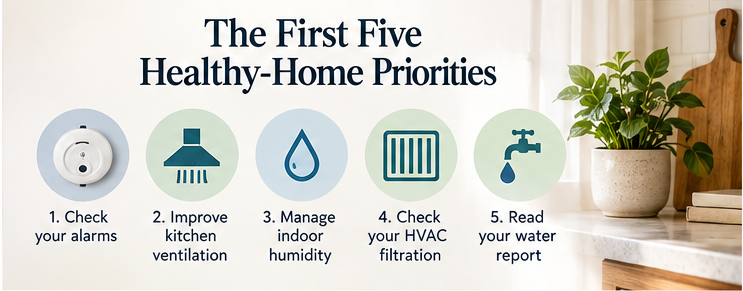
The first five: where to start in almost any home
Check your alarms. Carbon monoxide alarms belong on each level of the home and outside sleeping areas; test them monthly. This matters most if you have gas appliances or an attached garage.
Vent the kitchen to the outdoors. If you cook with gas, use a range hood that exhausts outside. Gas stoves are a common indoor source of nitrogen dioxide.
Keep humidity under 60%. EPA recommends indoor humidity below 60%, ideally 30% to 50%, and drying any leak or spill within 24 to 48 hours. In a Gulf Coast climate this one does a lot of work.
Upgrade and change your HVAC filter. EPA recommends a MERV 13 filter or higher in central systems if the system can handle it. Ask your HVAC technician what yours can take.
Read your water report. It takes ten minutes and tells you whether a filter would solve anything. See Is Your Tap Water Safe in The Woodlands?
Two more if they apply: test for radon once (EPA recommends testing every home, even in low-radon areas), and if your home was built before 1978, plan for lead-safe practices before sanding or renovating painted surfaces.
Kitchen
Item | Label | Why | First step |
|---|---|---|---|
Tap water | Prioritize (checking, not buying) | Your report answers most questions | Find your report; filter only for a specific problem |
Range hood / ventilation | Prioritize | Gas burners are an indoor source of nitrogen dioxide; EPA advises venting to the outdoors | Run a hood vented outside while cooking; clean or replace its filter |
Stainless steel and cast iron | Keep | Durable and well understood | No change needed |
Nonstick pans in good condition | Keep | No need to discard intact pans used as directed | Follow the maker's heat guidance |
Nonstick pans that are scratched or flaking | Consider | A worn coating is a reasonable signal to replace | Replace as they wear out, not all at once |
Plastic food containers | Keep, then Consider | Fine for cold storage; FDA notes some plastic containers can melt from the heat of food in a microwave | Microwave only in cookware made for microwave use, such as glass or ceramic or containers labeled microwave-safe; retire warped or cracked ones |
Drinking water. Most homes on regulated public water do not need treatment to have drinkable water. If taste is the issue, a certified carbon pitcher or faucet filter is inexpensive. If your report shows something you want lower, choose a filter certified for that specific contaminant.
Cooking and ventilation. EPA's advice for gas stoves is simple: vent to the outdoors and keep combustion appliances maintained. A hood that only recirculates air back into the kitchen does not vent to the outdoors, so check which kind you have.
Cookware. There is no need to clear the cabinet. Replace damaged pieces as they wear out, and when you buy new, choose what fits how you cook. A fuller cookware decision guide is coming.
Food storage. Keep the containers you have for cold storage. Heating is where the label matters.
Cleaning, laundry and fragrance
Item | Label | Why | First step |
|---|---|---|---|
Products you already own | Keep | Using them up is fine | Use with ventilation and as labeled |
Mixing products | Prioritize | CDC: never mix bleach with ammonia or any other cleaner | Use one product at a time; store them closed and out of reach |
Replacing a cleaner | Consider | EPA's Safer Choice label means every ingredient was reviewed and VOC limits apply | Look for the label when you next restock |
Plug-in air fresheners and sprays | Consider | EPA lists air fresheners and aerosol sprays among household VOC sources, and many VOCs run higher indoors | Use less, ventilate, or skip if you notice irritation |
Candles | Keep, with ventilation | Occasional use is a reasonable choice | Burn in a ventilated room; trim wicks |
Fragrance covering a musty smell | Prioritize | A musty odor can point to moisture or mold | Find the source rather than masking it |
Laundry products | Keep | Low priority for most homes | Consider fragrance-free if anyone in the home is sensitive |
Fewer products is often the simplest change: an all-purpose cleaner, a dish soap and one disinfectant cover most homes.
Bathroom
Item | Label | Why | First step |
|---|---|---|---|
Exhaust fan | Prioritize | Showers add moisture; EPA advises running the fan or opening a window | Run it during and after showers; check that it actually pulls air |
Leaks and soft caulk | Prioritize | Small leaks feed mold | Fix drips; re-caulk where it has failed |
Shower filter | Consider, only if chlorine bothers you | Shower filters certified to NSF/ANSI 177 cover free chlorine only | Skip unless you notice a chlorine issue |
Personal care products | Keep | Outside the scope of a home walkthrough | Change on your own schedule |
Bedroom
Item | Label | Why | First step |
|---|---|---|---|
Mattress and pillows | Keep | No need to replace a comfortable mattress to be "healthier" | Replace when worn or uncomfortable |
Bedding | Keep, then Consider | Regular washing is the main habit | Wash on a steady schedule |
Alarms near sleeping areas | Prioritize | CO alarms belong outside sleeping areas | Confirm one is there and working |
Humidity | Consider | Damp rooms are where mold and musty smells start | Check with an inexpensive hygrometer |
Air, humidity and HVAC
Item | Label | Why | First step |
|---|---|---|---|
HVAC filter | Prioritize | EPA recommends MERV 13 or higher if your system can handle it | Ask your technician; set a change reminder |
Indoor humidity | Prioritize | Below 60%, ideally 30% to 50% | Buy a hygrometer; use AC and a dehumidifier as needed |
Combustion appliances | Prioritize | EPA advises having heating systems inspected and serviced by a professional every year | Schedule yearly inspection |
HVAC with suspected mold | Prioritize | EPA advises not running a system you suspect is contaminated | Call a qualified HVAC professional |
Portable air purifier | Consider | Useful where central filtration is limited | Size it to the room; it does not fix moisture |
Furniture, renovation and materials
Item | Label | Why | First step |
|---|---|---|---|
Existing furniture | Keep | Replacing working furniture is not a first-step priority | No change needed |
New furniture, paint and finishes | Consider | EPA lists paints and solvents among VOC sources and advises ventilating when using them | Ventilate after painting or delivery; buy only what you will use |
Pre-1978 painted surfaces | Prioritize before renovating | EPA: homes built before 1978 are more likely to have lead-based paint; renovation dust is the concern | Hire a lead-safe certified firm for work that disturbs paint |
Radon | Prioritize once | Montgomery County is EPA Zone 3 (low), but EPA recommends testing every home | One inexpensive test |
What not to worry about this month
A calmer home is also a home where you are not chasing every headline. It is fine to leave these for later: replacing working furniture, emptying the pantry of plastic containers, buying a whole-house water system without a reason from your water report, or testing for mold when you cannot see or smell it.
Frequently asked questions
Where should I start? The first five above: alarms, kitchen ventilation, humidity, HVAC filter and your water report.
Do I need to throw out my nonstick pans? Not if they are in good shape. Replace them when the coating is damaged.
Are candles and air fresheners bad? They add to indoor air, so ventilation matters. Using less is a reasonable change; using them to cover a musty smell is the one to stop.
Do I need an air purifier? Start with your HVAC filter and humidity. A portable purifier is useful in rooms central filtration does not reach well.
Should I test for radon in Montgomery County? EPA rates the county as low radon potential but still recommends testing every home once.
Want a second set of eyes?
This walkthrough is the same order we use in a Better Smarter Health Personal Concierge Reset: we go room by room with you, note what to keep, and leave you with a short, prioritized list instead of a shopping cart. If you would rather start on your own, print the First Five list.
Want a simpler place to start?
Get the free Healthy Home First Five checklist and focus on the five things worth checking before you start replacing products around your house.


